




Plan Your
Bitcoin Future
A free Bitcoin price forecasting, investment, and retirement calculator — built around Michael Saylor's ARR model and the Power Law. My attempt to answer the question: if Bitcoin keeps going up, what does that mean for my retirement?
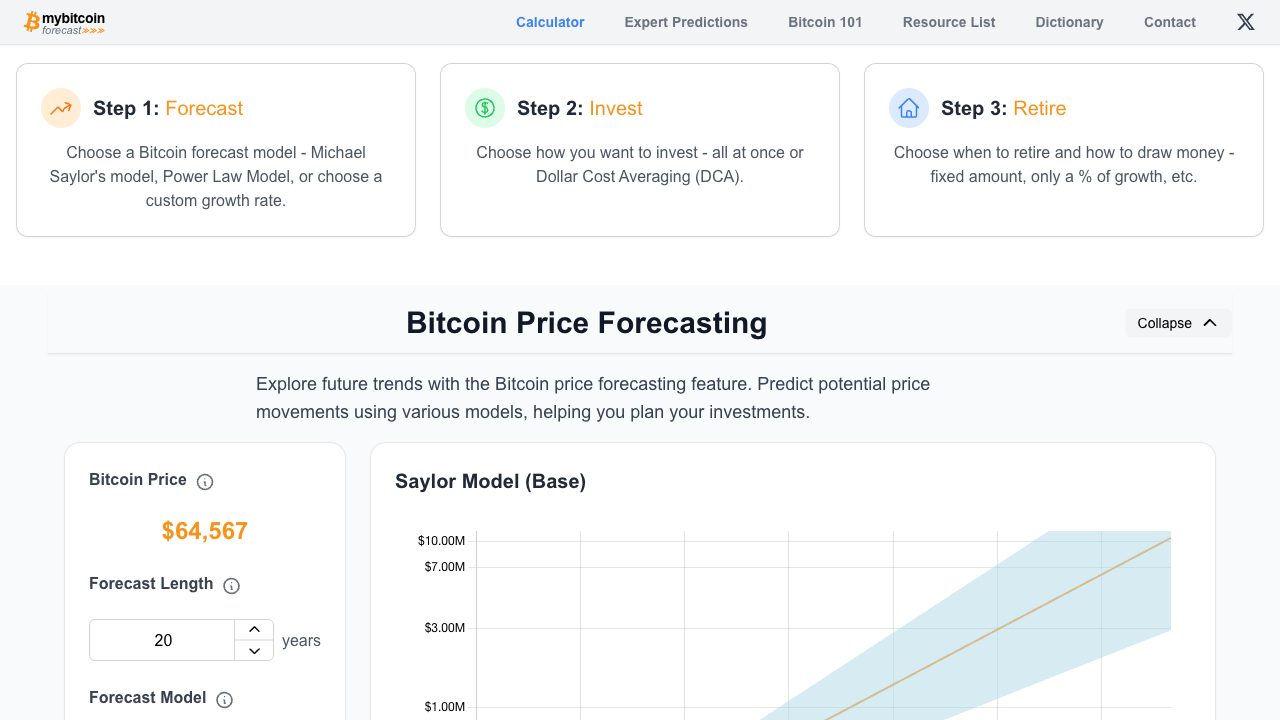
$13M+ by 2045
It started with a spreadsheet
I've been buying Bitcoin since it was around $100. Then at $1,000. Then $10,000. Each time I added more conviction, but I didn't really have a rigorous way to think about what that meant for my financial future.
So I started building a spreadsheet. I wanted to model out scenarios — if Bitcoin hits X price by Y year, and I DCA in Z dollars per month, when can I retire? What does that look like? What's a reasonable forecast to plan around?
About halfway through, I realized: this would make a great online calculator. Not just for me — for anyone trying to think seriously about Bitcoin as part of their long-term financial plan. When Bitcoin crossed $100,000 in January 2025, that was the moment everything crystallized for me.
"We're in this beautiful moment where a lot of the risk is gone. We know a lot of upside is coming."
After more than a decade, Bitcoin has proven itself. It's survived every attempt to hack it. It's worked through code improvements. Government regulations are bringing clarity. It's a $3 trillion asset. You're not getting the 10,000x returns of the early days, but you're also not taking the same risk. To me, it's still a wonderful time to get in — and building the right tools to think about it clearly matters.
I started building this in March 2025 and continue to update it every few months as I personally need new features.
Three tools in one
The app walks you through a full Bitcoin financial plan — forecast the price, model your investment, then plan your retirement.
Forecast
Choose a price model — Saylor's ARR, Power Law (bullish/neutral/bearish), or a custom growth rate. See an interactive chart of future Bitcoin price out to 50 years.
Invest
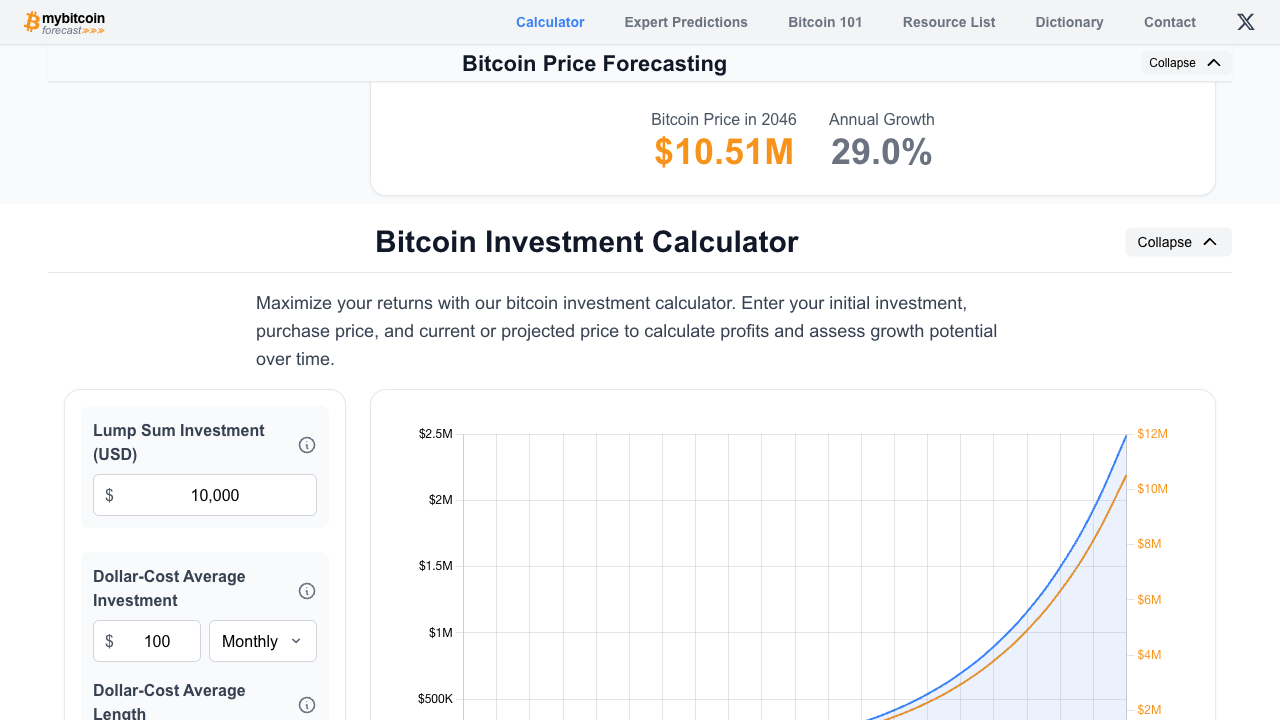
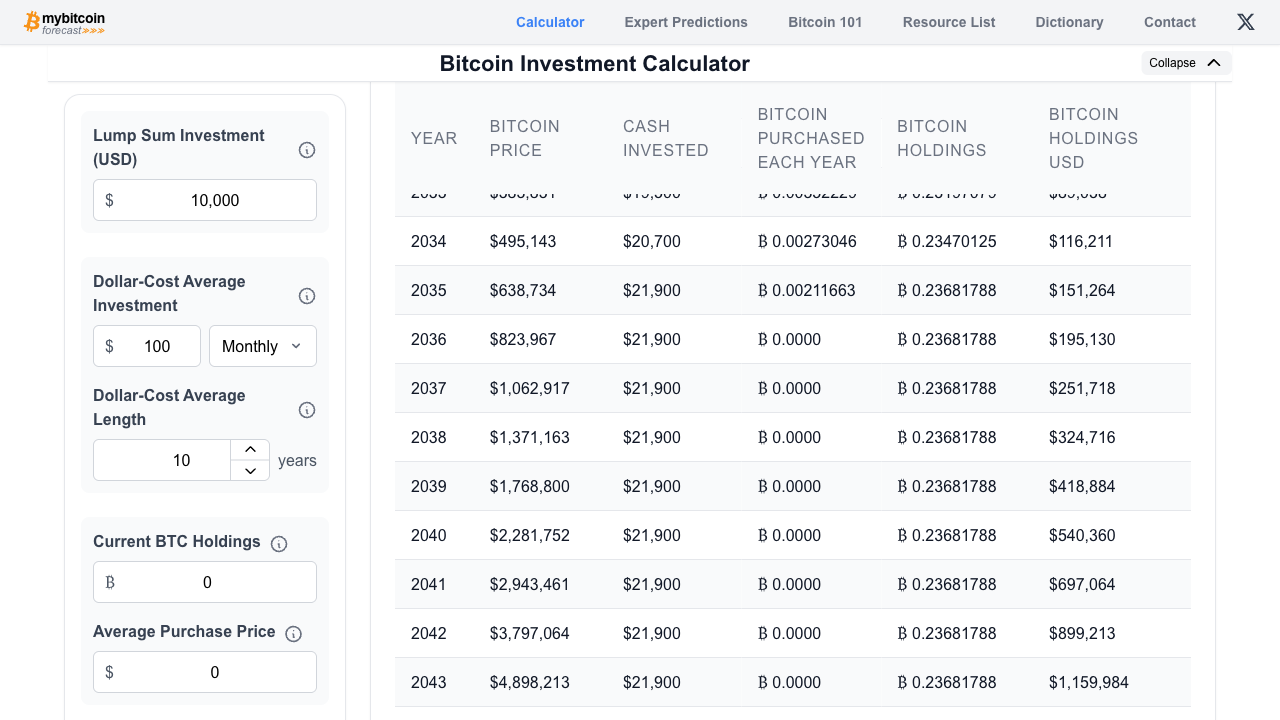
Enter a lump sum, a DCA amount and frequency, or both. The investment calculator shows your projected holdings and USD value year by year, with optional inflation adjustment.
Retire
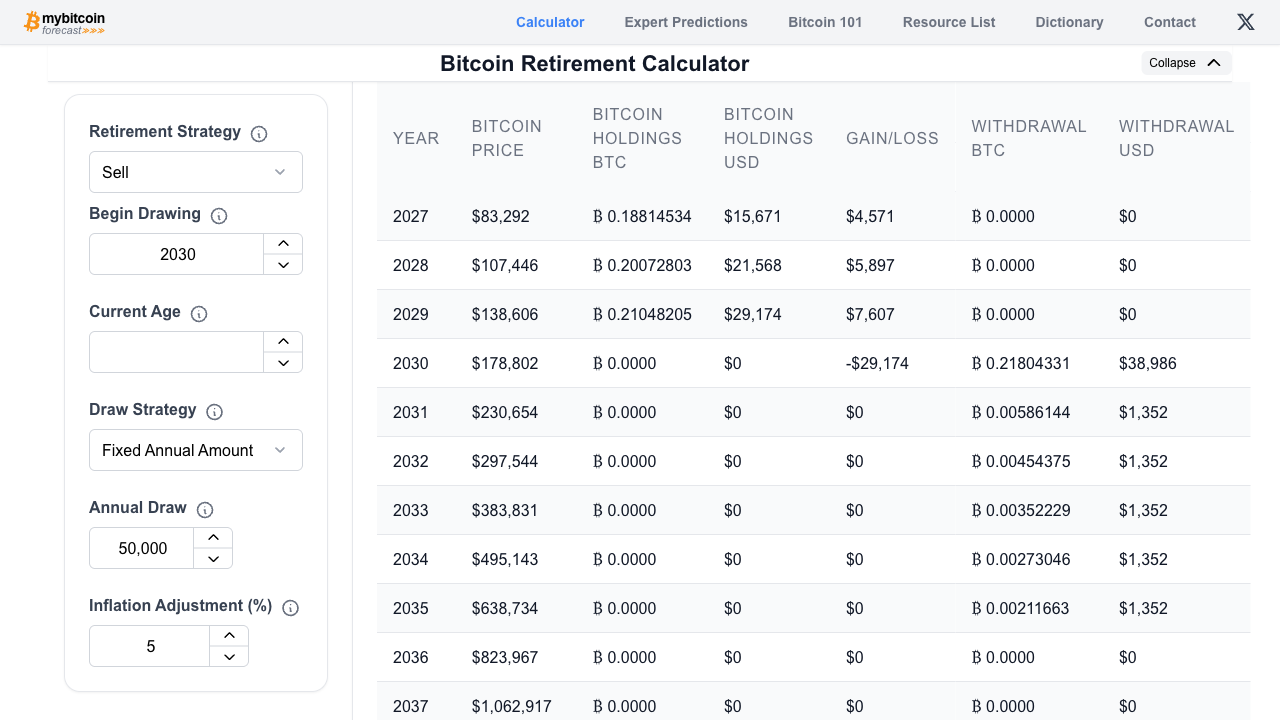
Set a target retirement year or desired annual income. Choose a withdrawal strategy: sell down the nest egg, live off growth only, or a modest hybrid approach.
Why Saylor?
Michael Saylor brought a lot of clarity to Bitcoin for me. His level of conviction is inspiring, but more than that — his rigorous framework around where Bitcoin has been, where he expects it to go, and why, helped make me a true believer. He didn't just say "number go up." He built a model.
I'm not reinventing Saylor's research. I'm leveraging it. He has far more resources than I do, and he has his actual business on the line behind this conviction. His base case: Bitcoin reaches ~$13 million by 2045, representing roughly 29% annual returns. That's the number I build the calculator around, alongside the Power Law model as an alternative lens.
"He's got actual money and his business on the line. He presents his model, and I get to piggyback off of it."
The calculator supports multiple models so users can stress-test their assumptions — Saylor's ARR model, the Power Law (with bullish, neutral, and bearish variants), Stock-to-Flow, and a fully custom growth rate if you want to input your own assumptions.
The stack
A Next.js web app with Chart.js doing the heavy visual lifting. Supabase caches the live Bitcoin price from CoinMarketCap so the app stays fast without hammering the API. Everything runs on Vercel.
What was hard
Keeping everything in sync
The hardest part wasn't any single calculation — it was making all the data on the page consistent. There's a lot happening at once: forecast data feeds into investment calculations which feed into retirement projections. When a user changes a single variable — say, the forecast model — everything downstream needs to recalculate and update correctly. Getting all those data dependencies right, and keeping the tables and charts synchronized, took the most iteration.
The retirement math
The retirement section has three different withdrawal models — sell down the nest egg, live only off growth, and a hybrid modest growth approach — each with inflation adjustments and different behaviors depending on whether the user sets a target year or a target income. Getting the edge cases right (what happens if growth outpaces withdrawals? what if the user outlives their Bitcoin?) required a lot of careful modeling.
A personal tool that became a public tool
I built the first version for myself. That means the original design assumptions were "good enough for me" — but making it usable for anyone, with any investment situation, required generalizing a lot of logic I'd originally hard-coded around my own numbers. That's an ongoing process.
The plan going forward
The app is and will remain completely free. There's no monetization right now — I just want it to be a genuinely helpful tool for people thinking seriously about Bitcoin. Maybe someday it makes money. For now, it's a public service.
The next feature I'm considering is an estate planning calculator. If I want to set up my children for life using Bitcoin — how much do I need to accumulate? Based on their ages, the future buying power of Bitcoin, and what I want each of them to have, what does that number look like today? It's a natural extension of the retirement planning work and something I'm personally trying to figure out.
Beyond that, I add features as I personally need them. That keeps the roadmap honest — everything on this site is something I wanted to use.
Current status
- Live and free at mybitcoinforecast.com
- ~400 organic monthly pageviews
- Estate / generational planning calculator — in consideration
- Monetization — no plans yet
Plan your
Bitcoin future
Free. No account required. Just your numbers and a long time horizon.