




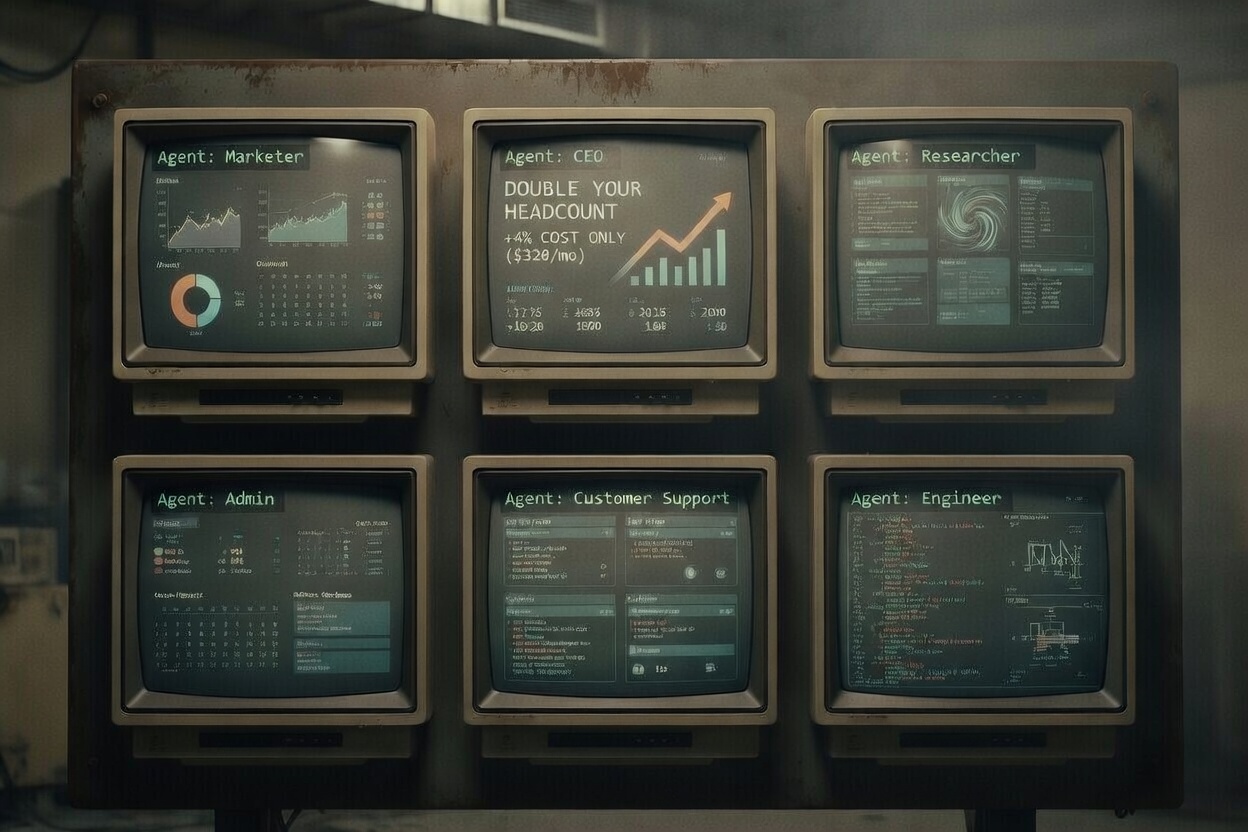
Stop Replacing People. Multiply Them Instead.
Turn one employee into a 200% team for $320 extra per month.
The AI Timeline (Last 6 Months)
The speed of progress has been staggering:
2025: Chat tools (ChatGPT, Claude, Grok) evolved by getting tools and skills to do meaningful work. No longer just Q&A — they could execute.
January 2026: Chat tools evolved into Agents. The OpenClaw Cambrian explosion. Agents use the same AI intelligence as chat interfaces but add tools, memory, and the ability to operate 24/7.
March 2026: Agents upgraded to Agent Teams. Tools like Paperclip.ing enable you to orchestrate a team of agents doing productive tasks around the clock. Each agent specialized in their own field.
Why This Matters to Every Company
Jensen Huang, the NVIDIA CEO, said every business needs an OpenClaw strategy. Every. Business. From solopreneur to mega-corporation, everyone can build a team of agents to do productive tasks in their business.
He said something else that stuck with me: companies without a vision will use AI to replace people, while companies with a vision will use AI to empower people to do more.
The Math
Average employee costs a business $96,000 per year. An AI agent costs roughly 4% more — about $320 per month per employee. For 4%, you could double your headcount by hiring one agent for each employee.
But is it really “doubling”? Only if the agent produces 100% the volume and quality of the employee. Let’s look at the realistic range.
Worst Case: 10% Produced
The employee delegates 10% of their work to the agent. Repetitive data entry, email drafts, report formatting, basic research. The agent handles it.
Still an improvement. You haven’t lost money. Could it get worse? Yes — if a user refuses to use the agent at all. But I firmly believe every role can see at least a 10% improvement if they’re halfway trying.
Average Case: 100% Produced
The agent matches the employee’s output volume and quality. You’ve doubled your headcount for 4%. This is a very good deal.
Best Case: 200%+ Produced
The employee delegates 80% of their work to the agent. The remaining 20% is creative, strategic, edge-case work — the things humans are best at. The human focuses on high-judgment decisions.
Then the employee hires 3 more agents. They have 4 agents total, running 24/7. No holidays. Works on weekends. Now you have 200%+ work output from one employee.
Realistic? Yes. Will every employee be able to do this? No. But some will, and those people become 5x more valuable to the organization.
The Progression
You don’t start at 200% on day one. It’s a progression:
Week 1-2: Employee learns the agent tools. Delegates one small task. Gets comfortable.
Week 3-4: Employee identifies 3-5 recurring tasks to delegate. Agent handles them reliably.
Month 2: Employee has a rhythm. 20-30% of work is agent-handled. They start thinking about what else could be delegated.
Month 3: Employee manages 2-4 agents. They spend most of their time on creative direction, quality review, and strategic decisions. They’re a manager of an AI team.
30-90 days with effort. That’s the realistic timeline.
The Vision Problem
A company without vision thinks replacing 200 people with AI — reducing expenses, increasing profits so shareholders applaud the temporary stock price bump — is a good move. It’s not. It’s short-sighted.
A recent study showed that companies spent billions on AI in 2025 but overall growth was stagnant. Why? I believe the stagnation came from a lack of vision. They bought AI tools but didn’t rethink how work gets done.
A company with vision asks: What if we could double our headcount for an extra 4%?
That’s not a cost-cutting question. That’s a growth question. And growth compounds.
It Takes Effort
Agents and Agent Teams are not a magic button. It takes effort and skill to get this working. You need clear instructions, good guardrails, quality review processes, and patience to iterate.
But when it clicks? It’s a massive unlock.
The companies that figure this out first will have a structural advantage that’s very hard to catch.
Don’t replace people with AI. Multiply them.