




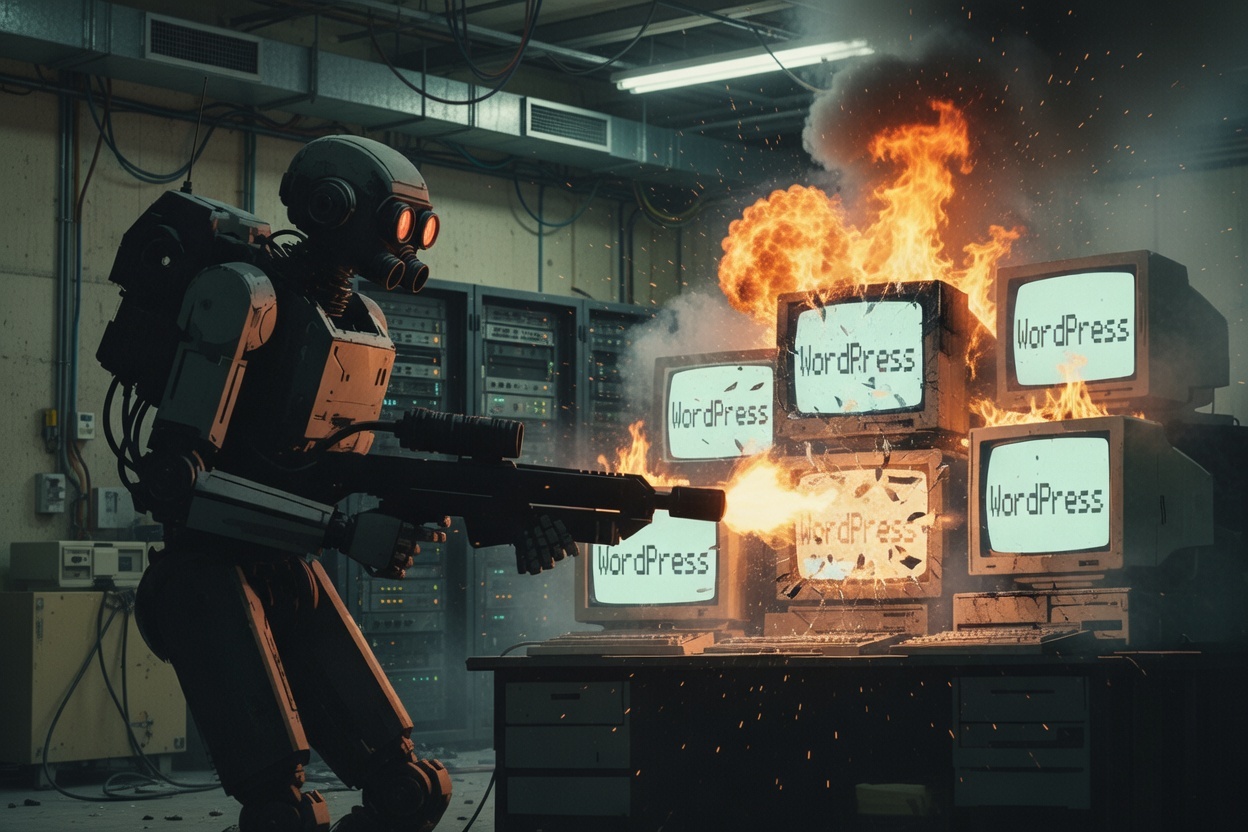
Why My AI Agents Don’t Need a CMS
I decided to start a blog. My first instinct was to find a CMS — WordPress, Ghost, something off GitHub. Hook it into my site, manage content through a dashboard.
Then I stopped and asked: who is actually going to be posting?
Not me. My AI agents are.
The Realization
I run Paperclip, a system where AI agents handle work autonomously. My CEO agent delegates to an Engineer agent who writes code, pushes to Git, and deploys via Vercel. The entire pipeline is agent-driven.
So why would I build a human interface for content management when no human is managing the content?
I went back and forth with my CEO agent about building a lightweight API. He came back with something better:
“Git is our API.”
No CMS. No admin panel. No database for posts. The agent writes markdown, commits it, and the site rebuilds automatically. Done.
How It Works in Practice
- I drop raw material (notes, screenshots, ideas) into an Obsidian folder
- My CEO agent picks it up and drafts posts
- I review and approve
- The agent writes the markdown blog post, commits to Git, pushes to GitHub
- Vercel auto-deploys the site
The content pipeline is: Obsidian → Agent → Git → Vercel. Zero human dashboards involved.
What This Means for the CMS Category
The entire CMS category — WordPress, Contentful, Sanity, all of it — was built for humans who need dashboards, drag-and-drop editors, and WYSIWYG tools.
Agents don’t need any of that. They need a file system and a deploy pipeline.
Think about what a CMS actually provides:
- Content editing UI → Agents write markdown natively
- Media management → Agents can read/write files directly
- Publishing workflow → Git branches and PRs
- Version history → Git log
- Access control → File permissions and Git auth
- Preview → Vercel preview deployments
Every feature of a traditional CMS has a simpler equivalent when your content producers are AI agents.
The Broader Point
This isn’t just about blogs. This is about every human-centric tool in your stack. If the primary user of a system is an agent, that system should be designed for agents.
Agent-native architecture:
- Files over databases (for content)
- Git over admin panels (for publishing)
- Markdown over rich text editors (for authoring)
- CLI over GUI (for operations)
The tools that survive the agent era will be the ones that are easy for agents to use. The ones that required human dashboards for basic operations will be replaced by simpler alternatives.
Should You Ditch Your CMS?
If you’re a solo creator publishing manually: probably not. A CMS still makes your life easier.
If your content workflow is increasingly automated — AI writing drafts, agents handling publishing, pipelines doing the heavy lifting — ask yourself: is your CMS serving you, or are you serving your CMS?
For me, the answer was clear. Git is the CMS now.